

Business intelligence using AI is redefining how organizations analyze data and make decisions. Traditional business intelligence dashboards are no longer sufficient to support real-time, predictive, and decision-driven operations. This is where business intelligence and artificial intelligence converge. Research shows that 88% of organizations already use AI in at least one business function,[1] signaling a shift from experimentation to enterprise-wide adoption.
Instead of simply answering “what happened,” AI-powered systems answer:
- What is happening now
- Why it is happening
- What will happen next
- What actions should be taken
This shift marks a fundamental evolution from static reporting to AI-driven decision intelligence.
Key Insights
- AI Business Intelligence I combines traditional analytics with machine learning and automation to transform data into predictive, actionable insights for decision-making.
- Growing data complexity, demand for real-time insights, and competitive pressure are driving organizations to adopt AI-powered analytics solutions.
- Core capabilities such as machine learning, natural language processing, automation, and predictive analytics enable AI-based business intelligence to function effectively.
- Successful implementation depends on strong data quality, governance, skilled teams, and measurable business outcomes such as efficiency, forecasting accuracy, and competitive advantage.
- LANSA BI supports this transformation by providing governed AI capabilities from data querying to insights generation and storytelling via direct integration with leading AI model providers.
Business Intelligence vs Artificial Intelligence: Understand the Basics
Business intelligence (BI) is a set of technologies and processes used to collect, analyze, and visualize business data to support decision-making. It focuses on transforming historical and current data into reports, dashboards, and insights that explain performance.
Artificial intelligence (AI) refers to systems that simulate human intelligence by learning from data, identifying patterns, and making predictions or decisions automatically. It focuses on automation, forecasting, and advanced analytics.
Key Differences
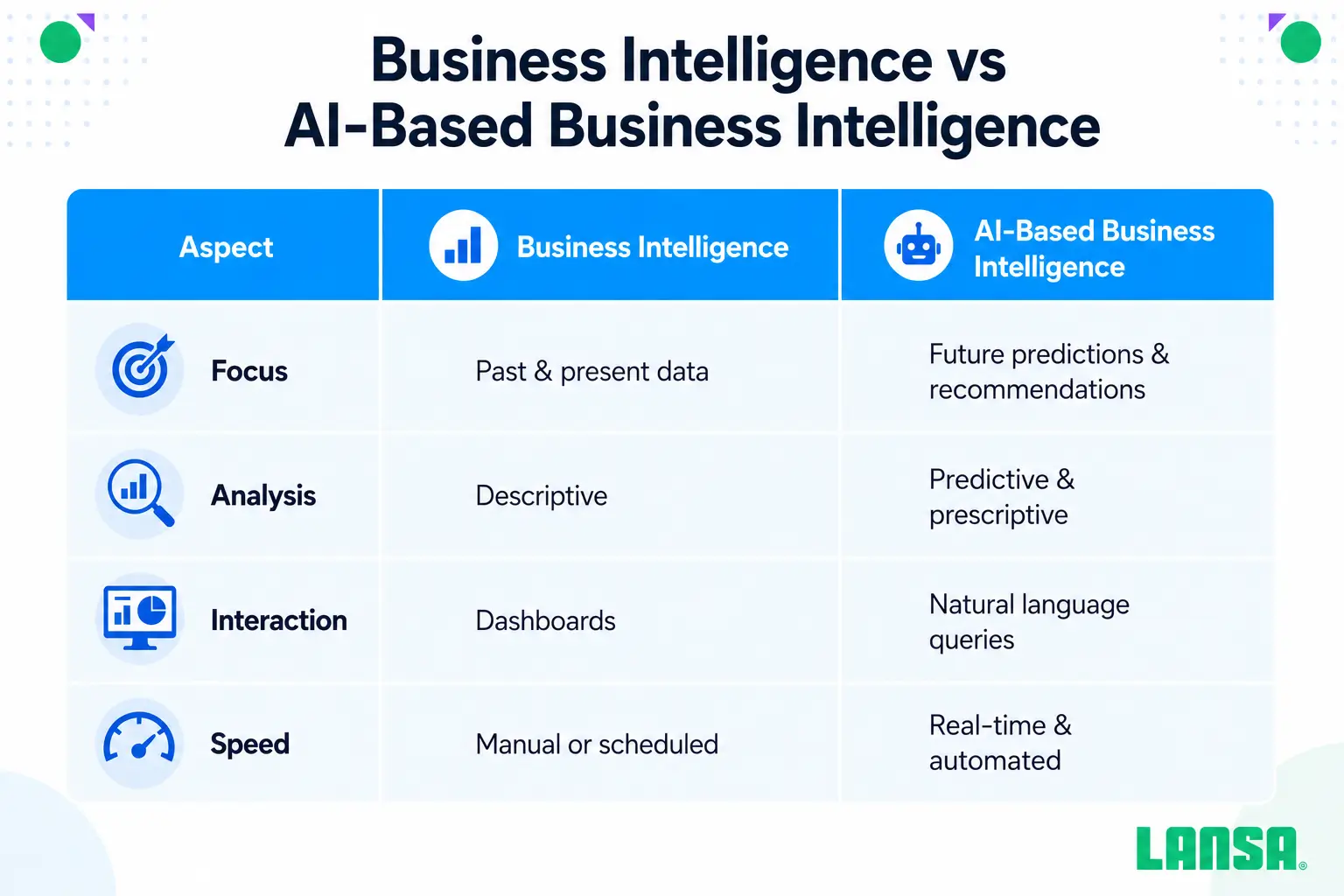
In short, BI explains the past, while AI enables the future.
What is the Role of AI in Business Intelligence?

The role of AI in business intelligence is to enhance analytics with automation, predictive insights, and real-time decision support, enabling organizations to move beyond static reporting.
Traditional BI relies on manual processes such as data preparation and report generation, which can slow down insights and limit responsiveness. With business intelligence using AI, these processes become faster, more intelligent, and accessible across the organization.
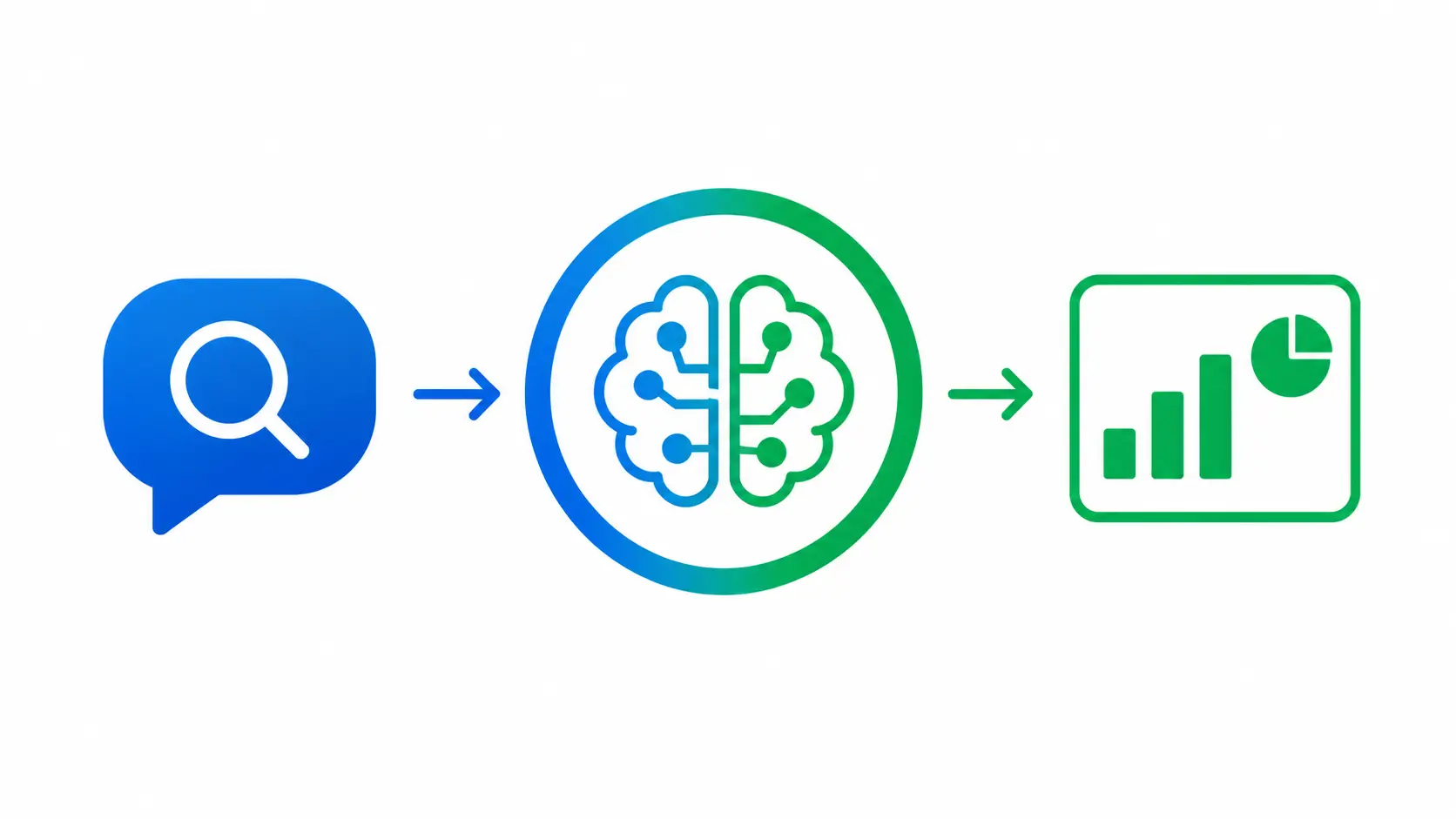
To better understand how AI transforms business intelligence workflows, the process can be visualized as a connected system — from raw data to automated decision-making.
Where LANSA BI Fits
LANSA BI brings these capabilities into a single AI-powered platform designed for enterprise use. It combines natural language querying, assisted insights generation, and automated report distribution to make up-to-date data more accessible and actionable for business users without compromising security and compliance. Embedded into business workflows and applications, it directly provides users with insights to make proactive decisions.
In its latest release, LANSA BI can now be integrated with leading AI model providers like OpenAI, Anthropic, and Google to further simplify analytics workflows and scale adoption. With generative capabilities, LANSA BI accelerates data exploration, reporting, and storytelling, supplying comprehensive intelligence to decision-makers within seconds.
How does AI Impact Business Intelligence: Understanding the Benefits
Business intelligence using AI fundamentally changes how organizations interact with data, shifting from manual analysis and delayed reporting to real-time, intelligent, and decision-driven insights.
Traditional BI tools focus on dashboards and historical reporting. While useful, they often depend on technical users, predefined queries, and slow reporting cycles. AI removes these limitations by embedding intelligence directly into the analytics process.
Faster Insight Discovery
AI significantly reduces the time required to move from raw data to actionable insight.
Instead of manually building reports or waiting for analysts, AI can:
- Process large datasets instantly
- Surface trends and anomalies automatically
- Generate insights in real time
Decisions that once required days or weeks can now be made in minutes, allowing organizations to respond faster to changes in the market.
Self-Service Analytics at Scale
One of the biggest shifts highlighted in modern BI is the move toward true self-service analytics.
AI enables this by allowing users to:
- Ask questions in natural language
- Explore data without technical skills
- Iterate quickly without relying on IT teams
This reduces dependency on specialized data teams and enables broader, organization-wide access to insights.
Example: A business user can ask, “Why did sales drop last month?” and receive not just a chart, but an explanation and contributing factors — without building queries or dashboards.
From Descriptive to Predictive Decision-Making
AI transforms BI from answering “what happened” to answering:
- What will happen next
- What should we do about it
Through predictive models, organizations can:
- Forecast demand
- Identify risks early
- Optimize strategies proactively
Organizations shift from reactive analysis to proactive, forward-looking decision-making, improving competitiveness and efficiency at scale.
Example: Instead of reacting to declining sales, AI predicts the drop in advance and recommends actions such as adjusting pricing or inventory.
Automated Reporting and Reduced Manual Work
A significant portion of traditional BI work involves repetitive tasks:
- Data preparation
- Report generation
- Dashboard configuration
AI automates these processes by:
- Cleaning and structuring data
- Generating queries and reports
- Recommending visualizations
Analysts can focus on higher-value work such as interpreting insights and driving strategy, rather than managing data workflows.
Smarter Data Storytelling
AI enhances how insights are communicated, enabling more effective data storytelling using LANSA BI.
Instead of static dashboards, AI-powered BI enhances how insights are presented, shared, and understood across the organization. It enables teams to transform analysis into clear, structured narratives that drive alignment and action.
- Translate insights into clear, audience-friendly narratives
- Connect key drivers and anomalies into a meaningful story that explains context and impact
- Recommend and assemble visuals that support the overall narrative
This improves clarity for stakeholders and accelerates decision-making across teams.
Example: Instead of presenting standalone charts, AI helps frame insights into a structured narrative, connecting trends with business context and clearly communicating their significance to stakeholders.
Improved Accuracy and Consistency
AI reduces human error by standardizing analysis and continuously monitoring data patterns, provided that underlying data is AI-ready and properly governed.
It helps:
- Detect anomalies automatically
- Maintain consistent metrics across systems
- Reduce bias in manual interpretation
Organizations gain more reliable insights, increasing trust in their BI systems.
Continuous, Real-Time Decision Support
Unlike traditional BI, which relies on scheduled reports, AI enables continuous insight generation.
AI systems can:
- Monitor live data streams
- Trigger alerts for critical changes
- Provide recommendations in real time
Decision-making becomes continuous rather than periodic, improving agility across the organization.
Example: A sudden spike in operational costs can be flagged immediately, allowing teams to investigate and respond before it escalates.
Why This Matters
The true impact of business intelligence with AI is not just efficiency — it is transformation.
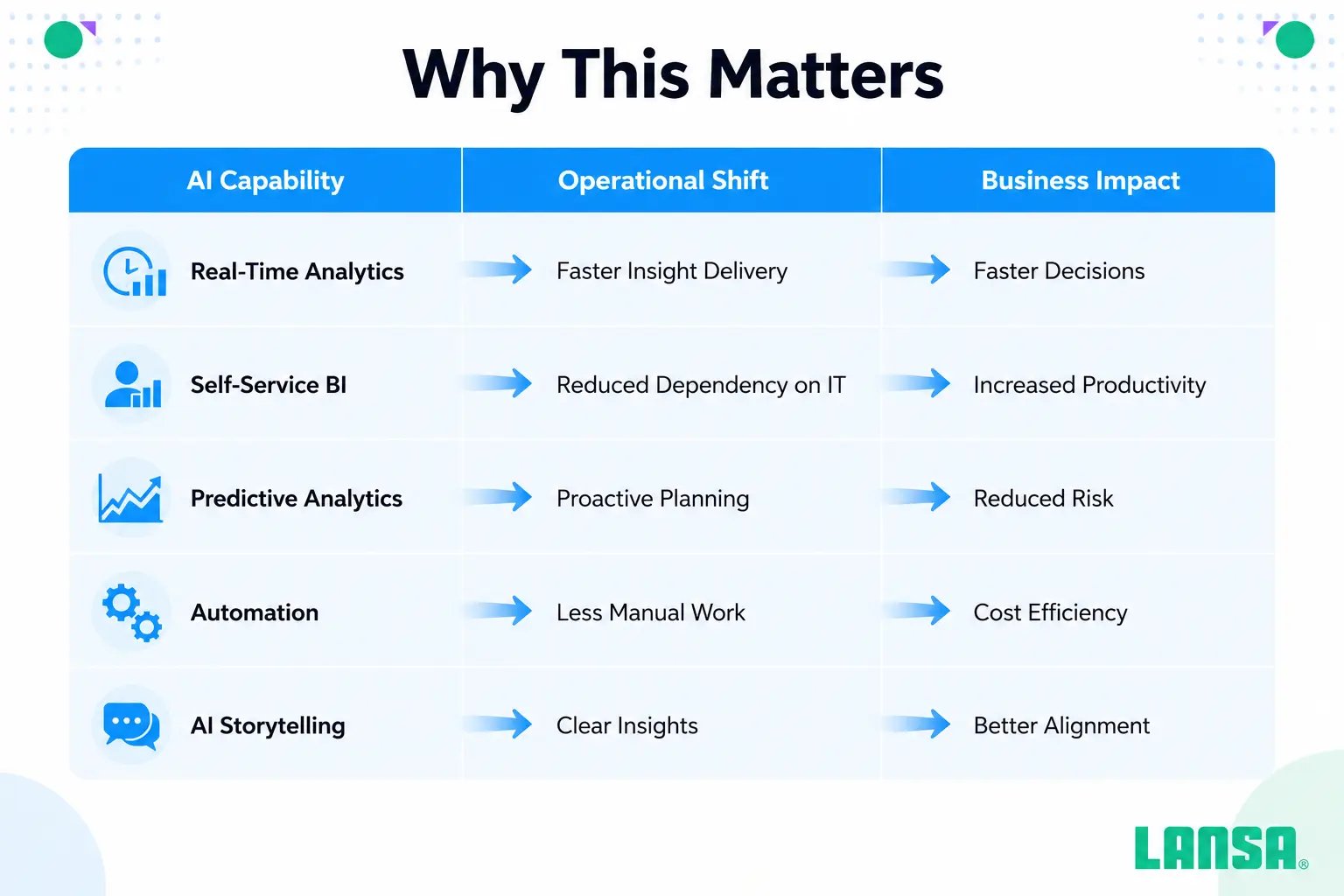
AI turns BI into:
- A real-time decision engine
- A self-service platform for all users
- A predictive system that drives action
Organizations that adopt AI-driven BI are not just analyzing data better. They are making faster, smarter, and more strategic decisions at scale.
Core AI Technologies used for BI
AI-based business intelligence relies on core technologies that enable advanced analytics, automation, and predictive decision-making, turning raw data into real-time, actionable insights.
Machine Learning Algorithms (ML)
Machine learning enables systems to learn from data and improve over time.
Use cases
- Customer segmentation
- Sales forecasting
- Fraud detection
- Churn prediction
ML is the foundation of AI business intelligence. However, the real value of machine learning in BI is not just prediction accuracy, but its ability to continuously learn from new data and adapt insights as business conditions change.
Natural Language Processing
Natural Language Processing (NLP), including capabilities like natural language query (NLQ), enables users to interact with data using everyday language instead of complex queries or technical tools. It transforms how users access insights by allowing them to ask questions conversationally and receive instant, accurate responses.
With AI-based business intelligence, NLP eliminates the need for SQL knowledge or predefined dashboards, making analytics accessible to both technical and non-technical users.
In LANSA BI, this capability is enhanced through AI-enabled Natural Language Query (NLQ). Users can simply ask questions as they would in a normal conversation, and the system automatically translates them into structured queries to retrieve relevant insights. This removes the need to learn syntax rules or understand underlying data structures, significantly lowering the barrier to entry for new users.
Additionally, LANSA BI provides:
- Suggested questions based on dataset metadata to guide exploration
- The ability to toggle AI mode on or off for flexible control
- Seamless conversion of results into reports, dashboards, or data stories
This makes business intelligence using AI more intuitive, scalable, and aligned with real-world decision-making workflows.
Robotic Process Automation (RPA)
RPA automates repetitive data tasks such as:
- Data extraction
- Report generation
- Workflow automation
This improves efficiency and reduces operational costs.
Automated Data Visualization
Automated data visualization uses AI to instantly transform raw data into meaningful charts, dashboards, and visual insights without manual configuration. Instead of selecting chart types or formatting data manually, the system intelligently determines the best way to present information based on context and patterns.
In AI-based business intelligence, this capability significantly reduces the time required to create reports while improving clarity and usability for decision-makers.
In LANSA BI, automated visualization is enhanced through AI-driven insights with “Tell Me About My Data” (TMAMD). This feature not only generates recommended charts but also provides plain-language explanations that highlight trends, anomalies, and key drivers within the data. These AI-generated visualizations are rendered as reusable, interactive charts that can be directly added to dashboards, reports, or data stories, minimizing manual effort and accelerating insight delivery.
Additionally, LANSA BI integrates an AI Story Assistant, enabling users to quickly build data narratives using AI-generated visuals and explanations. This allows teams to focus less on report creation and more on interpreting insights and making strategic decisions.
To ensure enterprise reliability, LANSA BI includes built-in governance controls, where data is analyzed internally before summaries are shared with external AI models, and access to AI features can be managed through role-based permissions.
This makes business intelligence using AI more efficient, scalable, and aligned with modern data storytelling needs.
Predictive Analytics
Predictive analytics uses historical data to forecast future outcomes.
Applications
- Demand forecasting
- Risk assessment
- Resource planning
This is one of the most powerful aspects of AI and BI integration. What makes predictive analytics valuable in modern BI is not just forecasting outcomes, but enabling organizations to act before issues materialize.
How AI Is Used in Business Intelligence Across Industries & Departments
Business intelligence using AI enhances traditional analytics by turning data into real-time, predictive, and actionable insights. Instead of just reporting what happened, AI enables organizations to understand why it happened, what will happen next, and what actions to take.
What distinguishes AI-driven use cases from traditional BI applications is their ability to connect insights directly to operational decisions, closing the gap between analysis and execution.
Customer & Marketing Analytics
With AI-based business intelligence, teams can connect fragmented customer data and uncover behavioral patterns that are not visible in standard dashboards.
- Predict customer churn
- Identify high-value segments
- Personalize campaigns in real time
Example: An e-commerce company notices declining sales in one region. Traditional BI shows the drop, but AI reveals the cause: delayed deliveries and shifting product preferences. Marketing teams can immediately adjust campaigns, offer targeted promotions, and coordinate with logistics to resolve the issue.
This allows organizations to move from reactive campaign adjustments to continuously optimized, data-driven customer engagement strategies.
Sales Intelligence
AI enhances BI by transforming static pipeline data into predictive insights that guide sales actions. Using business intelligence with AI, organizations can:
- Score leads based on likelihood to convert
- Forecast revenue more accurately
- Identify risks in the sales pipeline
Example: A sales team uses AI to analyze past deals and customer behavior. The system highlights which prospects are most likely to close and flags deals at risk. Sales reps can prioritize high-value opportunities and intervene early to improve conversion rates.
As a result, sales strategies become increasingly data-informed, reducing reliance on intuition and improving overall pipeline efficiency. This is especially valuable for improving sales and marketing insights across the organization.
Finance and Risk Management
Instead of periodic reviews, AI-powered BI can enable continuous monitoring and anomaly detection across financial data.
- Detect fraudulent transactions in real time
- Identify unusual spending patterns
- Improve risk assessment models
Example: A finance team tracks company expenses. AI automatically flags abnormal transactions, such as sudden spikes in vendor payments. This allows teams to investigate immediately, preventing financial loss and ensuring compliance.
This shift enables finance teams to transition from periodic reporting to continuous risk monitoring and proactive financial management.
Supply Chain & Operations
BI platforms integrate data across supply chain systems, and with AI, it can predict disruptions before they occur.
- Forecast demand accurately
- Detect supply chain bottlenecks early
- Optimize inventory and logistics
Example: A retailer uses AI to analyze historical sales, weather patterns, and supplier data. The system predicts a spike in demand for certain products and potential shipping delays. The company adjusts inventory levels and reroutes shipments to avoid stockouts.
This transforms supply chain management from reactive problem-solving into predictive and resilient operations.
Business Operations & Decision Support
AI in BI enables faster, self-service decision-making across teams.
- Ask questions in natural language
- Generate insights instantly
- Perform ad hoc analysis without waiting for reports
Example: An operations manager asks, “Which regions are underperforming this quarter?” The AI system instantly provides insights along with key drivers, allowing immediate action without relying on data analysts.
This decentralizes decision-making across the organization without compromising consistency or data accuracy.
Data and Analytics Teams
By automating technical and repetitive tasks, AI allows data teams to focus on strategic work.
Additional capabilities include:
- Automated data preparation and cleaning
- AI-generated queries and reports
- Faster dashboard creation
Example: A data analyst typically spends hours preparing datasets and building reports. With AI, these tasks are automated, allowing the analyst to focus on interpreting insights and advising business leaders.
This redefines the role of data teams from report builders to strategic advisors within the organization.
Key Challenges in AI-Driven Business Intelligence and How to Address Them
While business intelligence using AI delivers powerful capabilities, its success depends on more than just technology. Implementing AI in BI is an architectural, data, and governance shift that requires careful planning. Organizations that fail to address foundational issues often struggle with inaccurate insights, low adoption, and limited business impact.
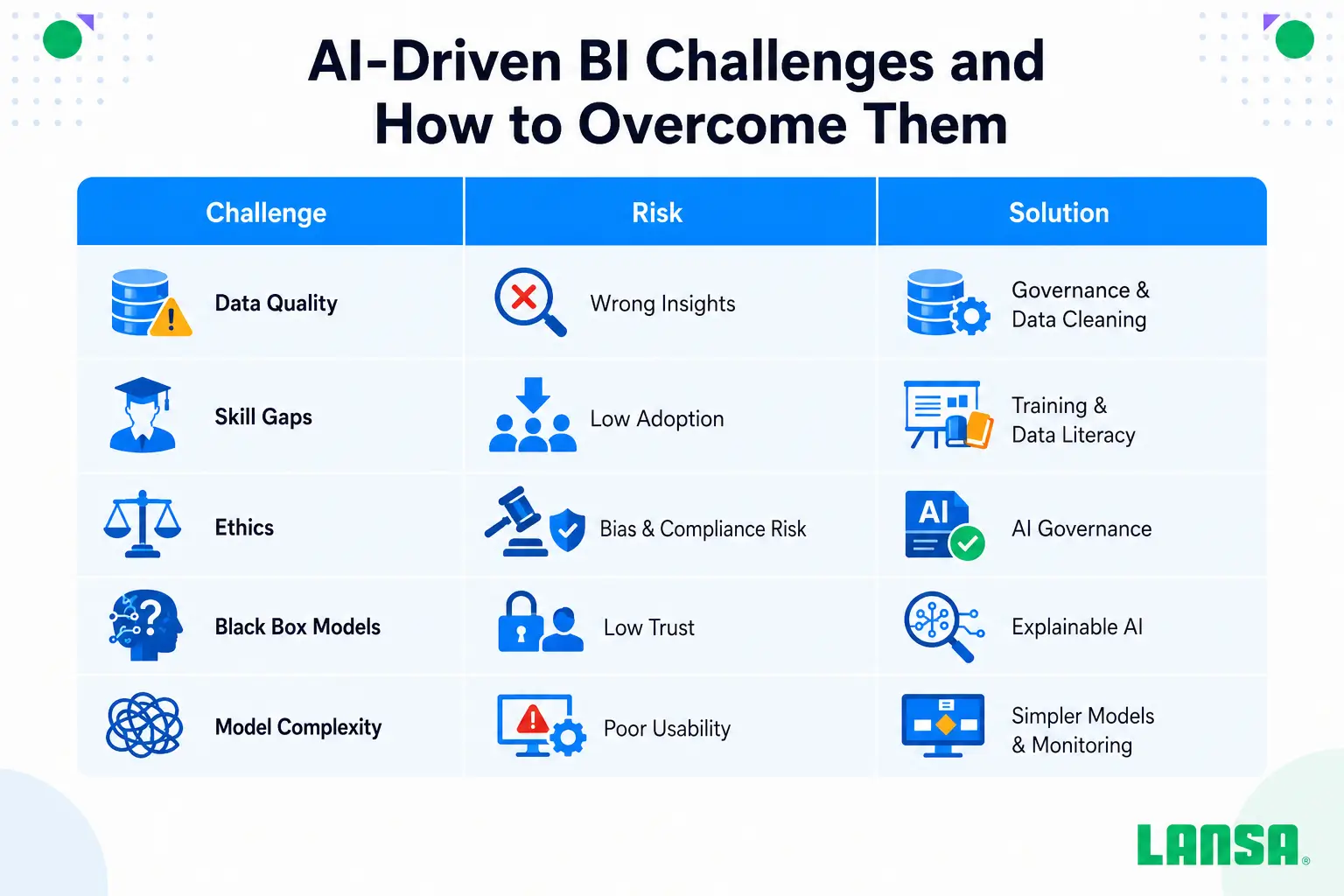
Data Quality Issues
Poor data quality remains the primary barrier to successful AI adoption in business intelligence. AI models rely on clean, consistent, and complete data. If the input is flawed, the output becomes unreliable.
Common issues include:
- Inconsistent data across systems
- Missing or outdated records
- Conflicting definitions between departments
- Fragmented data sources
Why it matters:
AI does not correct poor data quality — it amplifies it at scale. This leads to inaccurate predictions, misleading insights, and loss of trust in BI systems.
How to address it
- Implement strong data governance frameworks
- Standardize metrics and definitions across teams
- Automate data validation and cleansing processes
- Centralize data into a single source of truth
Organizations that prioritize data quality see improved accuracy, stability, and trust in AI-driven insights.
Skill Gaps
AI initiatives often underperform due to AI adoption challenges in organizations, particularly gaps in skills, data literacy, and organizational readiness required to effectively use and interpret AI-driven insights.[7]
Common challenges:
- Limited understanding of AI and data analytics
- Difficulty interpreting AI-generated outputs
- Resistance to adopting new technologies
Why it matters
Even the most advanced AI-based business intelligence tools will fail if users cannot trust or understand the results.
How to address it
- Provide role-based training programs
- Focus on practical, use-case-driven learning
- Promote data literacy across departments
- Encourage collaboration between business and data teams
Successful organizations treat AI adoption as both a technology and people transformation.
Ethical Concerns
AI introduces ethical risks, particularly around bias, fairness, and transparency, requiring responsible AI governance frameworks.[5]
Common issues:
- Biased training data leading to unfair outcomes
- Lack of transparency in decision-making
- Increased regulatory and compliance risks
Why it matters
Unethical AI can damage trust, create legal exposure, and negatively impact business reputation.
How to address it
- Establish clear AI governance and ethical guidelines
- Regularly audit models for bias and fairness
- Ensure transparency in how insights are generated
- Give users control over AI-driven decisions
Responsible AI is essential for sustainable adoption and long-term trust in AI systems.
Black Box Algorithms
Many AI models operate as “black boxes,” making it difficult to understand how decisions are made.
Common challenges:
- Lack of explainability
- Difficulty validating AI recommendations
- Reduced user trust and adoption
Why it matters
If users cannot understand or verify insights, they are less likely to act on them, limiting the value of business intelligence with AI.
How to address it
- Use explainable AI models where possible
- Implement human-in-the-loop validation
- Provide clear documentation and visibility into model logic
- Continuously monitor and refine model performance
Transparency is key to building confidence in AI systems.
Model Complexity & Interpretability
As AI models become more advanced, they also become harder to manage and interpret.
Common issues:
- Overly complex models that are difficult to maintain
- Performance degradation over time (model drift)
- Difficulty aligning outputs with business context
Why it matters
Complex models can deliver accurate predictions but fail to provide actionable insights if they are not aligned with business needs.
How to address it:
- Start with simpler, explainable models
- Continuously monitor model performance and accuracy
- Align models with clear business objectives
- Iterate and refine models based on real-world outcomes
AI should enhance decision-making through AI-driven decision support, not complicate it, while maintaining transparency, reliability, and effective risk control.[8]
The Future of BI is AI-Driven
As discussed, business intelligence using AI is shifting analytics from static reporting to real-time, predictive, and decision-driven systems. Organizations are no longer relying on dashboards alone. They are adopting AI-powered platforms that automate reporting, surface insights, and guide actions.
The future of business intelligence is increasingly defined by AI-driven capabilities such as:
- Conversational analytics instead of manual queries
- Automated insight generation instead of static reports
- Predictive and prescriptive decision-making instead of reactive analysis
- Scalable, governed AI embedded directly into business workflows
To support this evolution, organizations need platforms that combine AI capabilities with enterprise-grade governance and flexibility.
How LANSA BI Supports the Future of AI-Driven BI
LANSA BI is designed to deliver AI-powered analytics while maintaining control, security, and scalability for enterprise environments.
Key AI-driven capabilities include:
- AI-Enabled Natural Language Query (NLQ)
Users can ask questions in plain language without needing technical knowledge, making data accessible to both technical and non-technical users. - “Tell Me About My Data” (TMAMD)
Automatically generates insights, highlights trends and anomalies, and recommends visualizations to accelerate analysis and reporting. - AI Story Assistant
Transforms insights into structured data narratives, helping teams communicate findings and drive action faster. - Bring Your Own AI Model (BYO AI)
Organizations can integrate their preferred AI providers, including OpenAI, Claude, Gemini, or Azure models, allowing flexibility in performance, cost, and strategy. - Enterprise-Grade Governance & Control
Includes role-based access, usage monitoring, audit trails, and cost tracking to ensure compliance and transparency across AI usage. - Embedded AI Analytics
AI-powered insights can be integrated directly into applications, enabling real-time decision-making within business workflows.
References
[1] “The State of AI | McKinsey & Company.” https://www.mckinsey.com/capabilities/quantumblack/our-insights/the-state-of-ai
[2] “AI-Ready Data | Gartner.” https://www.gartner.com/en/articles/ai-ready-data
[3] “AI Readiness | Gartner.” https://www.gartner.com/en/information-technology/topics/ai-readiness
[4] “The Adoption of Artificial Intelligence in Firms | Organisation for Economic Co-operation and Development (OECD).” https://www.oecd.org/en/publications/the-adoption-of-artificial-intelligence-in-firms_f9ef33c3-en.html
[5] “Artificial Intelligence Policy Overview | Organisation for Economic Co-operation and Development (OECD).” https://www.oecd.org/en/topics/policy-issues/artificial-intelligence.html
[6] “Artificial Intelligence | National Institute of Standards and Technology (NIST).” https://www.nist.gov/artificial-intelligence
[7] “Enterprise AI Adoption Challenges: Why Many Organizations Struggle to Scale AI.” Medium. https://medium.com/@annaa05520/enterprise-ai-adoption-challenges-why-many-organizations-struggle-to-scale-ai-0a2fcceeb707
[8] “AI-Driven Decision Support: Explainable, Auditable Built Outcomes.” LinkedIn. https://www.linkedin.com/pulse/ai-driven-decision-support-explainable-auditable-built-outcomes-eeoge