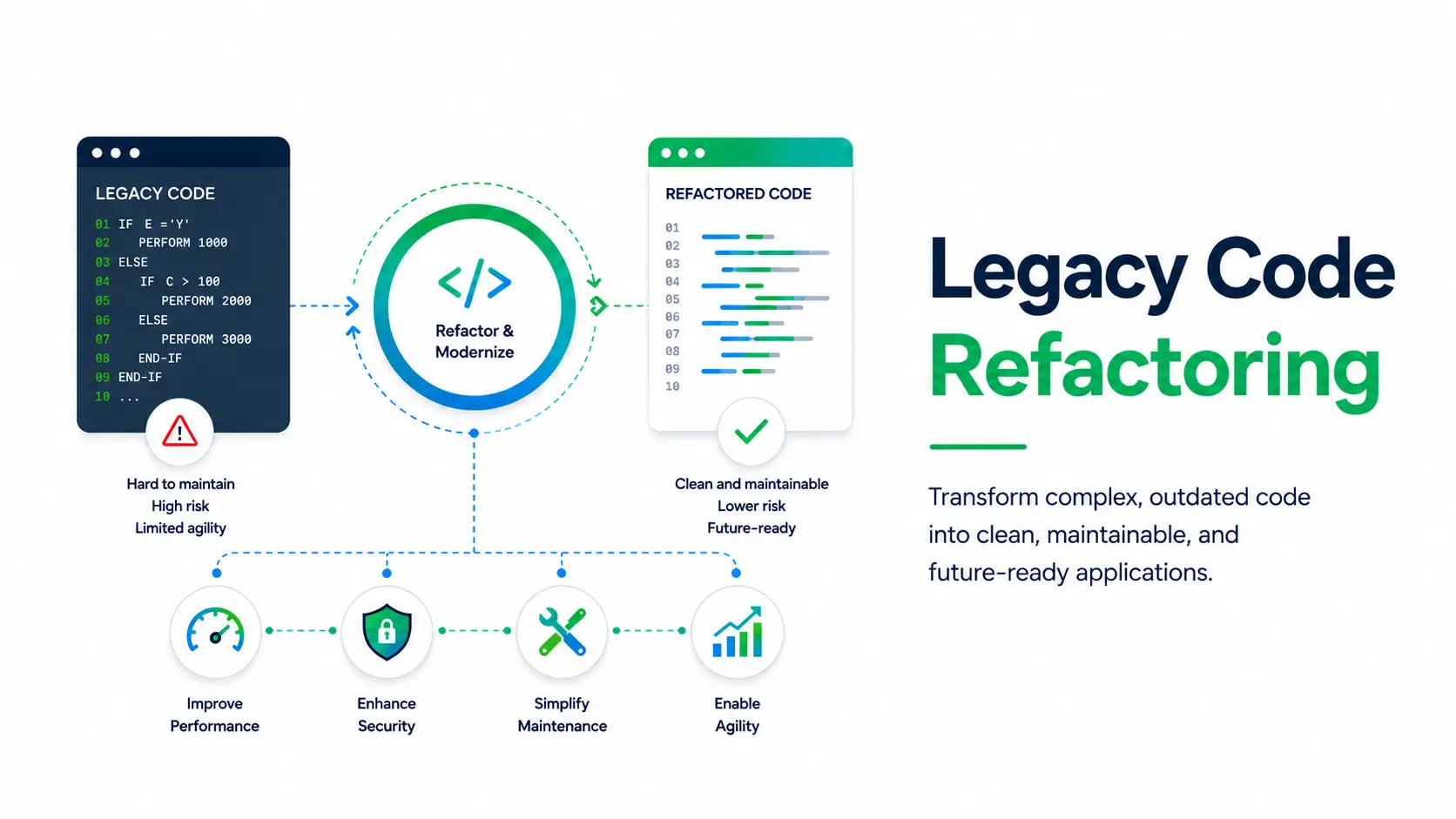
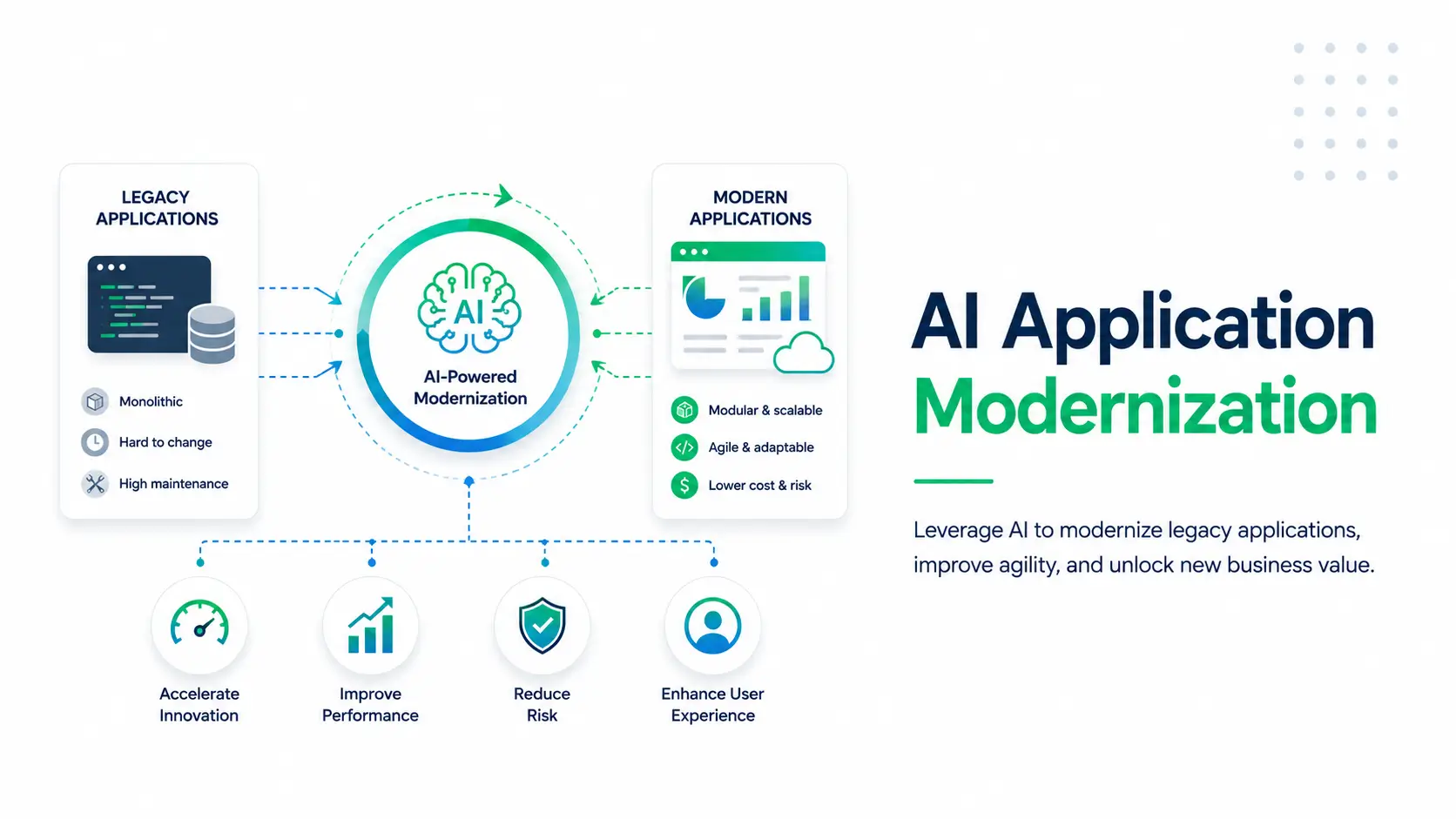


AI modernization has become a strategic priority for enterprises running mission-critical applications on long-standing legacy systems. These systems continue to power core business operations and contain years of proven business logic that organizations cannot simply replace. However, increasing demands for faster delivery, seamless integration, and greater flexibility are making it harder to evolve these systems using traditional approaches.
Modernization today is not about replacing legacy systems outright, but about extending their value while making them more adaptable and scalable. One of the most effective ways to achieve this is through code refactoring. The challenge is that manual refactoring is often slow, labor-intensive, and risky, particularly in large, complex environments.
This is where generative artificial intelligence (Gen AI) is transforming the process. In this article, we explore how Gen AI enhances each stage of application modernization, the practical ways organizations can adopt it, and how solutions like LANSA LAIR support efficient, low-risk legacy transformation.
Key Insights
- AI application modernization is the use of generative AI to analyze, refactor, and incrementally evolve legacy systems while preserving critical business logic and operational stability.
- The need for this approach is driven by growing system complexity, integration demands, and the limitations of traditional modernization methods in handling large, tightly coupled legacy environments.
- It works through a structured lifecycle that includes system analysis, dependency mapping, data-driven planning, AI-assisted refactoring, automated testing, and continuous optimization.
- Successful execution depends on phased implementation, data readiness, skilled teams, and measurable outcomes such as faster delivery, reduced risk, improved efficiency, and stronger business agility.
- LANSA supports this approach through LAIR by enabling AI-driven analysis and refactoring of legacy applications, helping organizations modernize safely, incrementally, and with greater strategic clarity.
What is the Impact of Generative AI on Application Modernization?
According to Artificial Analysis’s 2025 AI Adoption Survey , 66% of organizations are considering AI for engineering/R&D. [3] Generative AI is transforming application modernization by accelerating legacy analysis, enabling more informed modernization strategies, reducing development effort, and streamlining testing and deployment.
The impact of generative AI is most evident in organizations running mission-critical workloads on long-standing legacy platforms, where large codebases, tightly coupled architectures, and limited system visibility significantly increase the cost and risk of manual modernization efforts. These platforms include:
- SAP ECC
- IBM i (AS/400)
- Mainframe platforms
- COBOL-based systems
- Monolithic Java applications
Modernizing legacy systems is about extending their capabilities while preserving proven business logic. But limited visibility into complex codebases and dependencies makes the process slow, risky, and resource-intensive. As a result, many initiatives fail, up to 70% of digital transformations, and technical debt consumes nearly 40% of IT budgets [1][8]. Generative AI addresses these challenges by enabling faster code analysis, dependency mapping, and safer, incremental refactoring, helping organizations reduce effort, risk, and time to delivery.
Let’s break down where this impact shows up in practice.
1. Faster Legacy Analysis
Legacy analysis is often one of the biggest bottlenecks in application modernization. Before any changes can be made, teams need to understand how existing systems work—what depends on what, where critical logic resides, and how different components interact. This process is typically slow, manual, and dependent on limited documentation or internal knowledge.
AI helps address this challenge by accelerating legacy analysis, enabling teams to gain visibility into system structure and dependencies much earlier. As a result, organizations can move forward with modernization more quickly and with greater confidence.
2. Data-Driven Modernization Planning
Modernization efforts often stall because teams are forced to make decisions based on assumptions rather than actual system behavior. Without clear insight into usage patterns, dependencies, and business impact, it becomes difficult to determine what should be modernized first.
AI enables more data-driven planning by providing insights into how systems are used and how components interact. This allows organizations to prioritize modernization efforts based on real impact, reducing wasted effort and improving overall outcomes.
3. Reduced Refactoring Effort
Refactoring legacy systems is essential for modernization, but it is often time-consuming and complex—especially when working with large, tightly coupled codebases. Manually identifying what needs to be restructured and how to do it safely can significantly slow down progress.
AI helps reduce the effort required for refactoring by identifying opportunities to restructure code and simplify dependencies. This allows teams to modernize systems more efficiently while preserving existing business logic, rather than rewriting applications from scratch.
4. Improved Testing and Deployment Confidence
Modernizing legacy systems introduces risk, as even small changes can impact critical workflows. Testing is often incomplete or outdated, making it difficult to ensure that updates will not break existing functionality.
AI improves confidence in testing and deployment by expanding test coverage and identifying potential issues earlier in the process. This reduces uncertainty during releases and helps teams deploy modernization changes more safely and reliably.
5. Lower Technical Debt Over Time
As legacy systems evolve, technical debt accumulates, making systems harder to maintain and extend. Over time, this increases complexity and slows down future development efforts.
AI helps organizations manage and reduce technical debt by identifying inefficient structures, outdated components, and areas of high complexity. By addressing these issues proactively, teams can create systems that are easier to maintain and better suited for ongoing modernization.
6. Clear and Measurable Business Outcomes
Modernization initiatives are often evaluated based on tools or technical changes rather than actual business results. This can make it difficult to demonstrate value or measure success.
AI helps shift the focus toward measurable outcomes by enabling faster delivery, reducing operational risk, and improving system reliability. This allows organizations to track tangible improvements such as time-to-market, system stability, and user experience—ensuring that modernization efforts deliver real business value.
How Does AI Enhance Each Application Modernization Stage?
Application modernization is not a single step but a structured process involving discovery, planning, refactoring, testing, and continuous optimization. Generative AI enhances each stage by automating code analysis, identifying architectural risks, and accelerating refactoring tasks that traditionally required extensive manual effort.
Below is how AI contributes to each phase of legacy application modernization.
Stage 1: Discovery and Codebase Analysis
AI-assisted analysis tools can scan large codebases and build dependency graphs, call hierarchies, and control-flow mappings . By parsing the application structure and analyzing execution patterns, AI can identify tightly coupled modules, unused code, and high-risk integration points.
This automated discovery stage allows development teams to quickly understand system architecture and identify the safest modernization entry points.
Example: An enterprise modernizing an IBM i order management system uses AI-assisted code analysis to identify tightly coupled transaction workflows before restructuring them into modular services.
Stage 2: Modernization Planning
Once system dependencies and architecture are mapped, teams must determine which components should be modernized first.
AI can analyze application usage patterns, runtime telemetry, and performance metrics to prioritize modernization tasks based on business impact. Instead of relying on assumptions, teams can use data-driven insights to determine which modules should be refactored, exposed through APIs, or migrated to cloud-native environments.
Example: A retailer analyzes usage telemetry and identifies pricing and checkout systems as the most critical modernization targets, prioritizing them before lower-impact internal services.
Stage 3: Refactoring and Development
Generative AI helps accelerate refactoring by analyzing legacy code and suggesting modular structures compatible with modern frameworks.
AI-assisted tools can:
- Translate legacy languages into modern equivalents
- Generate REST API wrappers around existing logic
- Suggest modular service boundaries
- Refactor tightly coupled functions into reusable components
These capabilities allow teams to preserve proven business logic while modernizing the surrounding architecture.
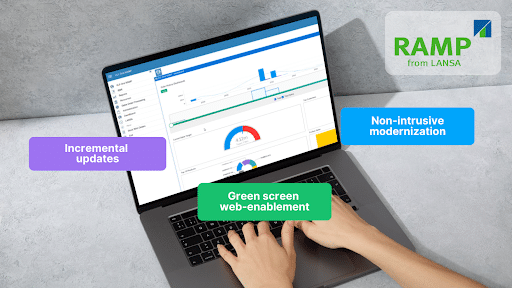
Example: A manufacturer modernizes green-screen operational dashboards by exposing legacy logic through APIs and building new web-based interfaces on top of the existing system.
Stage 4: Testing and Quality Assurance
AI can automatically generate unit tests, regression tests, and edge-case scenarios by analyzing code behavior and execution paths. It can also identify fragile code segments that are likely to break during refactoring.
By expanding automated testing coverage, AI helps reduce deployment risk and ensures that modernized applications continue to behave as expected.
Example: A financial institution uses AI-generated regression tests to validate transaction workflows after refactoring legacy payment modules.
Stage 5: Deployment and Operations
After modernization changes are implemented, organizations must deploy updates without disrupting critical systems.
AI can support deployment by integrating with CI/CD pipelines, generating deployment documentation, and monitoring system behavior in real time. It can also detect anomalies during rollout and recommend rollback strategies if performance issues arise.
This helps organizations introduce modernization changes incrementally while maintaining operational stability.
Example: A logistics firm uses AI-based monitoring to detect performance bottlenecks after deploying modernized routing services.
Stage 6: Continuous Optimization
Modernization does not end after deployment. Systems must continue evolving as workloads and business requirements change.
AI-driven monitoring tools analyze system performance, identify optimization opportunities, and recommend architectural improvements over time. These insights help organizations maintain efficient systems while adapting to new operational demands.
Example: A manufacturer uses AI performance analytics to identify processing inefficiencies in a modernized inventory system and improve throughput without expanding infrastructure.
How To Modernize Legacy Systems with AI: Best Practices
Successfully modernizing legacy systems with AI requires more than following a fixed sequence of steps. Organizations need a practical approach that focuses on visibility, incremental change, and measurable outcomes to ensure modernization efforts deliver real value without disrupting critical operations.
1. Start with System Clarity, Not Assumptions
Before introducing AI, ensure you understand how your system actually works in production.
Best Practices:
- Map application flows and identify tightly coupled modules and critical dependencies
- Focus on areas that directly impact business performance or user experience
- Avoid relying on outdated documentation or assumptions about system behavior
2. Prioritize Based on Business Impact
Modernization should focus on what drives value, not just what is easiest to change.
Best Practices:
- Identify high-impact components such as customer-facing systems or revenue-critical workflows
- Align modernization goals with measurable business outcomes like speed, reliability, or cost reduction
- Sequence efforts to deliver incremental value early
3. Prepare Data for AI Effectiveness
AI-driven modernization depends on clean, structured, and accessible data.
Best Practices:
- Cleanse and standardize data across legacy systems
- Ensure data is accessible for analysis without disrupting operations
- Establish processes to maintain ongoing data quality
4. Apply AI Where It Delivers Immediate Value
AI should be used to solve specific bottlenecks, not applied broadly without purpose.
Best Practices:
- Use AI for code analysis, dependency mapping, and refactoring insights
- Automate repetitive or low-value tasks to reduce engineering effort
- Focus on use cases that reduce risk or accelerate delivery timelines
5. Adopt an Incremental Modernization Approach
Large-scale transformations increase risk; incremental changes improve control and outcomes.
Best Practices:
- Start with pilot initiatives to validate results before scaling
- Introduce modular changes instead of full system rewrites
- Continuously measure progress and refine the approach
6. Enable Teams and Support Adoption
Technology alone does not drive modernization—people do.
Best Practices:
- Upskill teams to work effectively with AI-assisted tools
- Encourage collaboration between business and IT stakeholders
- Communicate clearly to reduce resistance and ensure alignment
7. Continuously Monitor and Optimize
Modernization is an ongoing process, not a one-time initiative.
Best Practices:
- Track performance, reliability, and business outcomes post-implementation
- Use AI insights to identify further optimization opportunities
- Maintain governance, security, and compliance across evolving systems
Key Drivers of AI-Powered Application Modernization
There are numerous compelling reasons to opt for AI-assisted application modernization.
But let’s run through them once more and see what really drives enterprises to adopt generative AI in application modernization.
- Improved User Experience – Modern interfaces and intuitive workflows reduce friction for end-users, boosting adoption and engagement across legacy applications. In fact, you can do green screen modernization without even writing the code.
- Business Agility – AI-assisted modernization allows legacy IT systems to quickly adapt to shifting market conditions and business priorities.
- Cost Efficiency – Smarter automation and optimized processes lower operational and maintenance costs, freeing resources for innovation.
- Faster Deployment – AI expedites testing, integration, and release cycles, making modernization projects more predictable and timely.
- System Resilience – Modernized architectures improve uptime, handle scaling demands, and minimize disruptions from aging infrastructure.
- Security and Compliance – AI identifies vulnerabilities, enforces policies, and ensures legacy systems meet evolving regulatory requirements.
- Data-Driven Decision Making – Insights from AI tools guide prioritization and strategy, ensuring investments in modernization deliver maximum value.
- Talent Enablement and Collaboration – Automation reduces repetitive workloads, allowing teams to focus on strategic initiatives and cross-functional collaboration.
- Innovation Enablement – Freed resources and modern platforms empower AI-driven new capabilities and business opportunities.
- Operational Visibility and Control – AI provides real-time monitoring, predictive analytics, and actionable alerts, giving leadership clear oversight of legacy modernization progress.
Implementation Challenges & How to Overcome Them
Of course, AI application modernization comes with its share of challenges. Organizations need to address gaps in skills, data quality, and infrastructure by using effective strategies for legacy modernization. Doing so ensures that modernization delivers real business value instead of getting stalled midway.
Let’s discuss the main challenges and practical ways organizations can tackle them effectively.
Challenge #1: Talent and Skills Gaps
AI-driven modernization demands expertise in both legacy systems and artificial general intelligence. Many IT teams lack experience in AI integration, leading to slower adoption and potential errors.
How to Mitigate Talent Gaps
- Partner with external AI specialists or consultants
- Upskill legacy IT teams through targeted AI training programs
- Encourage cross-functional collaboration between business and IT teams
Challenge #2: Data Readiness and Quality
Legacy systems often store inconsistent, siloed, or outdated data, which hinders AI-powered application modernization. Without clean and structured data, AI tools cannot deliver accurate insights.
Strategies to Address Data Challenges
- Standardize and unify data formats across systems
- Implement automated data cleansing and labeling pipelines
- Use automation tools to maintain ongoing data quality
Challenge #3: Infrastructure and System Compatibility
Older architectures may not support modern frameworks or generative AI platforms, creating roadblocks for deployment, integration, and scalability. Legacy systems often rely on tightly coupled components and outdated runtime environments, making it difficult to introduce AI capabilities without significant restructuring.
How to Overcome Infrastructure Issues
- Adopt hybrid or cloud-native environments to support scalable and flexible modernization
- Use API layers and microservices to bridge legacy systems with modern AI tools and applications
- Upgrade hardware selectively to support AI workloads and modern runtime requirements
- Use AI-assisted modernization platforms such as LANSA LAIR to analyze legacy architectures and dependencies, helping teams design modernization strategies that safely integrate legacy systems with modern environments
Challenge #4: Change Management Resistance
Modernizing legacy apps alters workflows, which can face pushback from staff and stakeholders.
Ways to Manage Change Effectively
- Communicate clear business value to employees
- Conduct hands-on training sessions and workshops
- Engage leadership to champion adoption and foster collaboration
Challenge #5: Vendor and Platform Selection
The global application modernization services market size was valued at USD 26.43 billion in 2025 [4]. It shows that organizations are going all in on legacy modernization.
But bear in mind, choosing the wrong vendor can create integration challenges and slow down modernization. Vendors with proven experience in legacy application modernization, such as LANSA, can help ensure smoother implementation and fewer technical roadblocks. Platforms like LANSA LAIR assist organizations by analyzing legacy code, identifying modernization opportunities, and supporting safer refactoring and API enablement of existing applications.
Tips for choosing the right vendor
- Review case studies relevant to your legacy systems
- Check compatibility with your existing IT infrastructure
- Confirm ongoing support and update policies
Conclusion: Accelerating Legacy Modernization with AI
Legacy systems continue to play a critical role in powering core business operations. Rather than replacing these systems outright, organizations are increasingly focused on evolving them in ways that preserve proven business logic while enabling greater flexibility, scalability, and integration with modern platforms.
As this article has shown, modernization is not a single step but a structured process that spans system analysis, planning, refactoring, testing, deployment, and continuous optimization. Across each of these stages, generative AI helps organizations move faster, reduce risk, and make more informed decisions—transforming what was once a slow and resource-intensive effort into a more manageable and strategic initiative.
The growing complexity of legacy environments, combined with increasing business demands, makes traditional modernization approaches difficult to scale. AI addresses this challenge by improving visibility into systems, enabling incremental change, and supporting more efficient modernization strategies without disrupting critical operations.
Within this broader shift, solutions such as LANSA LAIR (Legacy AI Refactoring) play a key role by helping organizations apply AI-driven refactoring in practice. By enabling teams to better understand, restructure, and extend legacy applications, these tools support safer and more effective modernization efforts.
Ultimately, organizations that adopt AI-assisted modernization approaches will be better positioned to extend the value of their existing systems while adapting to changing business needs—without compromising the stability and reliability their operations depend on.
References
[1] McKinsey & Company, “Breaking technical debt’s vicious cycle to modernize your business,” [Online]. Available: https://www.mckinsey.com/capabilities/tech-and-ai/our-insights/breaking-technical-debts-vicious-cycle-to-modernize-your-business
[2] Deloitte, State of AI in the Enterprise, Fifth Edition, 2024. [Online]. Available: https://www.deloitte.com/content/dam/assets-zone3/us/en/docs/services/consulting/2024/us-ai-institute-state-of-ai-fifth-edition.pdf
[3] Artificial Analysis, 2025 AI Adoption Survey. [Online]. Available: https://artificialanalysis.ai/
[4] Fortune Business Insights, Application Modernization Services Market Size, Share & Growth, [Online]. Available: https://www.fortunebusinessinsights.com/application-modernization-services-market-111580
[5] Wikipedia, Dependency Graph, 2025. [Online]. Available: https://en.wikipedia.org/wiki/Dependency_graph
[6] YouTube, Dependency Graph Explained (Video). [Online]. Available: https://youtu.be/r5LA7ivUb2c?si=PBxu2sSHLshyXNr_
[7] GeeksforGeeks, Software Engineering – Control Flow Graph (CFG), 2025. [Online]. Available: https://www.geeksforgeeks.org/software-engineering/software-engineering-control-flow-graph-cfg/
[8] Boston Consulting Group, “Flipping the Odds of Digital Transformation Success,” 2020. [Online]. Available: https://www.bcg.com/publications/2020/increasing-odds-of-success-in-digital-transformation