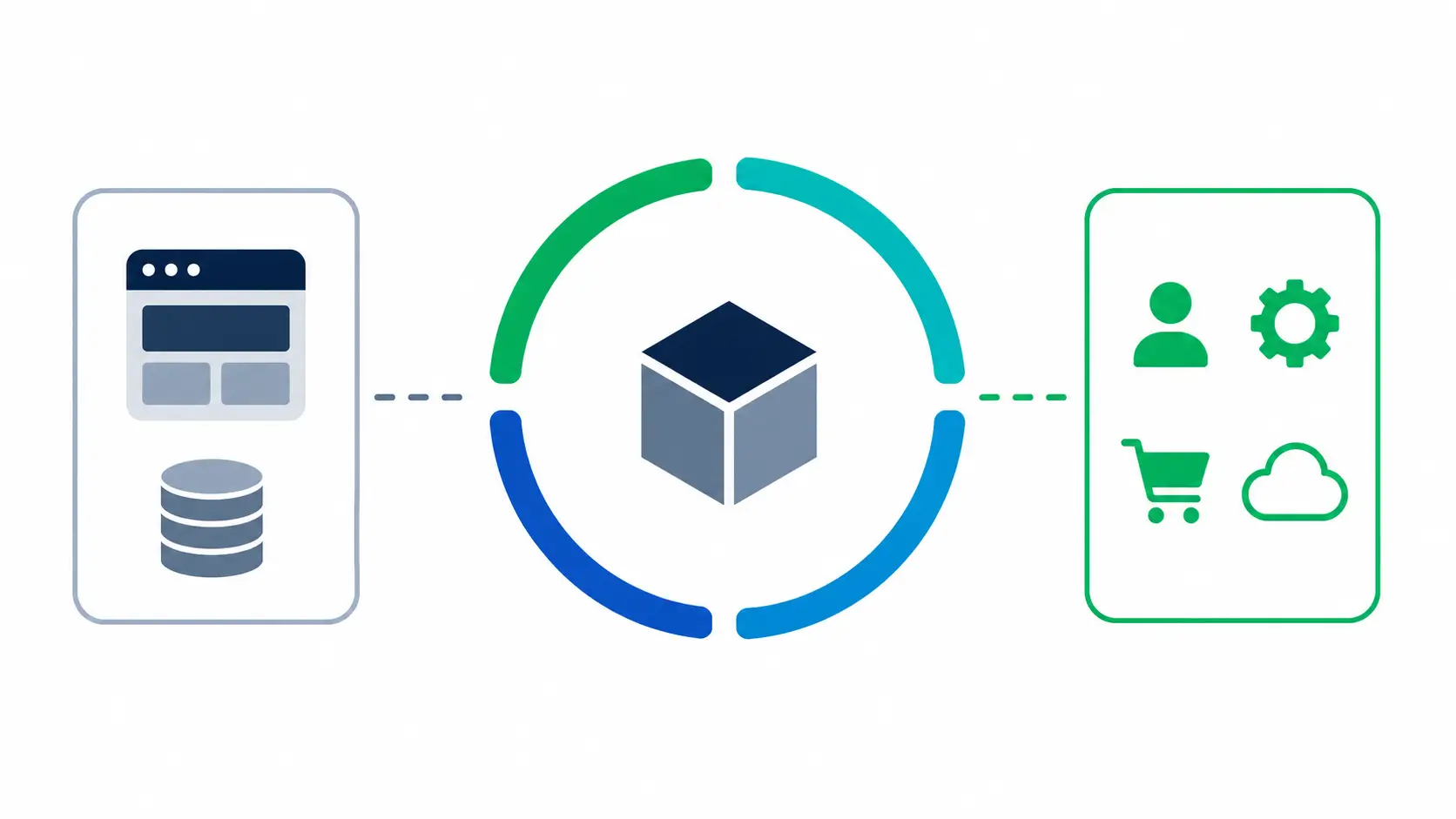



Composable architecture is changing how organizations build and modernize digital systems, especially as rigid platforms make it harder to adapt, integrate, and scale. Gartner forecasts that by 2026, at least 70% of organizations will acquire composable DXP technology, up from 50% in 2023, highlighting the growing shift toward more flexible digital architecture.
Instead of forcing every business function into one tightly coupled application, composable architecture allows teams to assemble the services they need, connect them through APIs, and evolve the system over time. For organizations under pressure to move faster, support more channels, and get more value from existing technology, it offers a more practical path forward.
Key Insights
- Composable architecture is a modern way of building digital systems using modular, API-connected components instead of one large, tightly linked platform.
- It has become more important as businesses face rising pressure to move faster, adapt to change, support more channels, and avoid the limits of rigid legacy systems.
- This approach works by combining reusable capabilities, modular services, API-first connectivity, and flexible deployment models that make systems easier to scale and evolve.
- Real success depends on careful implementation, strong governance, and a phased modernization strategy that improves agility, reduces technical debt, and delivers better long-term business value.
- LANSA supports this shift by helping organizations modernize with API-first integration, composable commerce capabilities, React storefronts, and deployment options that work with existing systems.
What Is Composable Architecture?
Composable architecture is an approach to software design where systems are built from smaller, independent capabilities rather than one monolithic application.Each part of the system is designed to do a specific job and connect with other parts through APIs.
That may sound technical, but the business idea is simple: instead of being locked into one oversized platform, organizations can choose the capabilities they need, replace them when necessary, and scale them more efficiently. This is why composable architecture is often described as more flexible, scalable, and future-ready than traditional approaches. It also overlaps with composable data architecture, depending on what part of the business is being modernized.
Core Characteristics of Composable Architecture
What separates composable architecture from a loosely assembled set of tools is the discipline behind how it is designed. Its core characteristics are what turn modularity into something the business can actually scale, govern, and adapt over time.
Modularity
Composable architecture is built around separate modules that each handle a defined function. That makes systems easier to update, test, and improve because teams can work on one area without disrupting everything else.
Reusability
Once a component is built well, it can often be reused across different applications, workflows, or channels. This reduces duplicated effort and helps teams move faster without rebuilding the same functionality again and again.
API-First Connectivity
APIs are what make composable systems work. They allow different services, tools, and platforms to communicate in a consistent way, which is essential when a system is made up of multiple moving parts. This is also why a strong API strategy matters so much in composable software architecture. Visual LANSA supports API-first development by helping teams expose business logic, connect applications and services, and build more modular systems that can evolve over time.
Learn how to create APIs with Visual LANSA
Interoperability
A composable system should not depend on every part coming from the same vendor or being built in the same language. Interoperability gives organizations more freedom to connect internal systems, third-party tools, and cloud services in ways that fit the business.
Scalability
One of the biggest strengths of composable architecture is that it allows teams to scale only what needs to grow. If demand spikes in search, checkout, or product content, those areas can be scaled independently instead of scaling the whole platform.
Flexibility
Business needs rarely stay still. Composable architecture makes it easier to add new channels, introduce specialized capabilities, support local market requirements, or replace outdated services without having to start from scratch.
Composable vs. Traditional (Monolithic) Architecture
The difference between composable and traditional architecture comes down to how systems are built, changed, and scaled over time. Traditional monolithic architecture bundles core functions into one tightly connected application, which can work well in simpler environments but often becomes harder to adapt as the business grows. Composable architecture takes a different approach by separating capabilities into modular, API-connected components that can be updated and managed more independently. This gives organizations more flexibility in how they modernize, integrate, and scale digital systems.
1. System Structure
In a traditional monolithic architecture, the application is built as one unified codebase where core functions are tightly coupled. That can make the system easier to launch initially, but harder to manage as complexity grows. In a composable architecture, the system is made up of smaller, modular capabilities that each perform a specific function, making the overall environment easier to adapt over time.
2. Flexibility and Change Management
Monolithic systems are generally harder to change because even small updates can affect the wider application and require broader testing and redeployment. Composable architecture is more flexible because individual components can be improved, replaced, or reconfigured without forcing changes across the whole platform. This is one reason composable models are better suited to fast-changing business requirements.
3. Scalability
Traditional monolithic platforms often need to be scaled as a whole when a specific function experiences increased demand, the entire application must be scaled rather than just the affected component. This leads to inefficient resource utilization, since not all parts of the system require additional capacity.
4. Maintenance and Upgrades
In a monolithic environment, updates are often more disruptive because tightly connected components increase the risk that one change will affect others. That slows release cycles and makes ongoing maintenance more difficult. Composable architecture simplifies this by isolating services and capabilities, allowing teams to update one area with less risk to the rest of the system.
5. Technology and Vendor Choice
Traditional architecture often keeps organizations tied to one platform or vendor ecosystem, which can limit flexibility and make future changes more expensive. Composable architecture supports a best-of-breed model, allowing teams to choose the tools and services that best fit each business capability instead of relying on a single all-in-one stack.
6. Integration and Interoperability
Monolithic platforms can be more difficult to integrate with external tools because they were not always designed for open, API-driven connectivity. As digital ecosystems grow, that limitation becomes more noticeable. Composable architecture is built around API-first connectivity, which makes it easier to integrate internal systems, third-party services, and new digital channels as business needs evolve.
7. Resilience and Downtime Risk
In a monolithic system, a failure in one area can affect the entire platform because the application is so tightly connected. This increases operational risk, especially as systems become larger and more complex. In composable architecture, failures are more likely to stay contained within a specific service or capability, which improves resilience and reduces the risk of full-system downtime.
8. Modernization Approach
Modernizing a monolithic platform often requires a larger, riskier transformation project because so many functions are interdependent. That makes change slower and more expensive. Composable architecture supports a more phased modernization path, where organizations can improve selected capabilities over time and reduce technical debt without forcing a full system replacement.
Typical Components in a Composable Architecture
Composable architecture is built from several core components that work together to create a more modular, scalable, and flexible system. Each one plays a different role in helping organizations separate business capabilities, improve interoperability, and modernize more gradually instead of relying on one tightly connected platform. This also aligns with MACH architecture, where modular services and API-first design support greater flexibility across the stack.
Packaged Business Capabilities (PBCs)
Packaged Business Capabilities, or PBCs, are modular business functions built around a specific capability such as pricing, promotions, product information, or customer management.[8] Instead of forcing every function into one large suite, PBCs allow organizations to assemble the capabilities they need in a more targeted way. This makes it easier to evolve the architecture over time while keeping technology decisions closer to real business priorities.
Microservices
Microservices are smaller, independent services that each handle a specific business or technical function. For example, an e-commerce platform might use separate microservices for product search, inventory, payments, and order processing. If customer demand increases during a major sale, the business can scale the search and checkout services without increasing resources for the entire platform. Likewise, the payment service can be updated or replaced without requiring teams to redeploy unrelated functions such as product content or inventory management.
Cloud Services
Cloud services provide the flexibility, resilience, and scalability that composable environments often require. They support faster deployment, elastic scaling, and more resilient operations, especially when different services need to grow at different rates. They also make it easier for organizations to support hybrid or phased modernization strategies rather than moving everything at once. This gives teams more freedom to place workloads where they make the most operational and commercial sense.
APIs
APIs are what connect the different parts of a composable architecture. They allow systems, services, and applications to exchange data and work together in a consistent way. Without strong APIs, even well-designed modular capabilities can become difficult to govern, integrate, and scale over time.
Headless CMS
A headless CMS separates content management from presentation, making it easier to deliver content across websites, mobile applications, and other digital channels. This gives organizations more control over how content is created, managed, and delivered across experiences.
In digital commerce environments, it also plays an important role in composable commerce strategies, where content, storefronts, and backend services need to work together more flexibly.
Key Benefits of Composable Architecture
As digital demands grow, the way systems are structured plays a bigger role in how effectively organizations can respond to change. Composable architecture offers a more adaptable foundation, helping businesses evolve their technology environment in a way that is more controlled, scalable, and aligned with long-term goals.
Reduced Technical Debt and Better Use of Existing Investments
Instead of continuing to work around legacy applications and piling on more technical debt, composable architecture gives organizations a more practical way to modernize over time. Teams can separate high-friction capabilities, expose core business logic through APIs, and improve the parts of the system that need more flexibility without replacing everything at once. This helps reduce the custom workarounds, dependencies, and maintenance burden that make older environments harder to change. At the same time, organizations can keep valuable systems and proven business logic in place while extending the value of existing investments more strategically.
Best-of-Breed Vendor Choice Without Lock-In
Instead of accepting one vendor’s strengths and weaknesses across the whole stack, businesses can choose the tools that best fit each capability. That creates more flexibility in the short term and more negotiating power over time. It also makes it easier to replace underperforming tools without disrupting the broader architecture.
Faster Innovation and Time to Market
Independent services and reusable components make it easier to release updates and launch new digital experiences faster. Teams can move more quickly because they are not waiting on one large application to change all at once. This allows the business to test ideas, respond to market shifts, and deliver improvements more quickly.
Global Scalability and Local Market Adaptations
Organizations can standardize what should be shared across markets while still supporting local payments, fulfillment, content, and compliance requirements. This balance is especially important for businesses trying to grow globally without losing local relevance. A composable approach makes it easier by allowing shared capabilities and market-specific services to work together within the same broader architecture.
Faster Partner and Ecosystem Onboarding
API-driven systems simplify onboarding for external partners by reducing the amount of custom integration work required. That can speed up collaboration with suppliers, distributors, marketplaces, and other ecosystem participants. It also helps organizations expand partner networks more efficiently as business needs and market opportunities evolve.
Industry-Specific Customization Through Specialized Capabilities
Composable architecture makes it easier to introduce niche capabilities that fit a specific industry, workflow, or customer need without reshaping the whole platform. For example, a healthcare organization could add a specialized patient scheduling and insurance verification service while keeping its existing billing, records management, and communication systems unchanged.
Operational Efficiency and Higher Value Through Orchestration
The real value comes from how these capabilities work together. When services are connected well, the business gets more value from the ecosystem than from any one platform on its own, improving efficiency while supporting more coordinated digital experiences. For example, in composable commerce, inventory, pricing, payment, and fulfillment services can work together to automatically show accurate product availability, apply the correct promotion, process the payment, and route the order to the best fulfillment location.
Improved Resilience and Reduced Downtime Risk
Because services are more isolated, one issue is less likely to bring down the whole environment. For example, in a composable commerce system, a temporary failure in the product recommendation service would not necessarily stop customers from browsing products, completing checkout, or placing orders.
Stronger Security Through Segmentation and Control
Segmented systems can improve security and control, especially when combined with strong API governance, access management, and monitoring. In practice, this makes it easier to contain risk and apply security controls more precisely across the architecture.
How Composable Architecture Supports Digital Transformation
Digital transformation often sounds like a full reset, but in reality most organizations cannot afford to rebuild everything at once. That is where composable architecture becomes valuable.
It gives businesses a way to modernize in phases by introducing modular services, better APIs, and more flexible frontends while continuing to use existing systems where it still makes sense. This supports faster delivery, better customer experiences, broader integration, and a more practical path to cloud migration as systems evolve away from rigid legacy platforms.
6 Steps for Implementing Composable Architecture
Implementing composable architecture requires more than technical change. It calls for a deliberate rollout that balances modernization goals with operational stability, so the organization can evolve its architecture without creating unnecessary risk or disruption.
Assess the Current Architecture and Business Capabilities
Start by identifying what the current environment does well, where the bottlenecks are, and which capabilities create the most friction or business risk.
Identify Key Modular Components
Not everything should be separated at once. Focus first on high-value areas where modularization can improve business agility, operational efficiency, customer experience, and scalability.
Decide on Appropriate Technologies
Determine which platforms, services, and integration tools are needed to support the capabilities being modernized, making sure they can work with existing systems, scale with demand, support future change, and remain manageable over time.
Develop an API Strategy
Set standards for API design, documentation, security, and lifecycle management early so the architecture stays manageable as it grows.
Start Gradually
A phased approach reduces disruption. Many organizations begin with a pilot area, prove value, and expand from there.
Evaluate and Optimize Accordingly
Composable architecture is not a one-time project; it requires continuous optimization in composable architecture, where performance, adoption, and business outcomes are regularly reviewed and improved over time.
Implementation Challenges & Considerations
Composable architecture can create a more flexible foundation for growth, but it also requires a different level of architectural and operational discipline. The shift is not just about adopting modular technologies. It is about making sure the organization can manage greater coordination, governance, and long-term complexity as the environment evolves.
Architectural Complexity
More components can create more coordination overhead, so service design, observability, and documentation matter. For organizations running legacy IBM i applications, teams must also identify which business logic should remain in place, which functions should be exposed through APIs, and where new modular services should be introduced. Without clear dependency mapping and governance, adding modern components around IBM i systems can increase integration complexity instead of reducing it.
API Governance and Lifecycle Management
Teams need clear standards for API design, security, documentation, versioning, ownership, and performance so integrations remain consistent and manageable as the architecture grows. Beyond APIs, organizations also need lifecycle management across the components, services, and integrations that make up the composable environment. That means defining how capabilities are introduced, updated, monitored, deprecated, and eventually retired, so flexibility does not turn into fragmentation, duplicate tools, or unnecessary complexity.
Operating Model and Change Management
Composable architecture often changes how teams work, not just the technology they use. Ownership, workflow, and governance need to evolve too.
Security and Compliance Concerns
More integrations and endpoints create more areas to secure, which makes access control, monitoring, and policy enforcement especially important. Organizations should also select vendors that prioritize security, provide regular updates and patches, and maintain clear compliance and vulnerability-management practices. This helps reduce the risk of outdated or poorly secured components weakening the broader composable environment.
Skills Gaps and Team Enablement
Composable architecture can reduce dependence on hard-to-find legacy skills by exposing existing business logic, modernizing selected capabilities, and connecting systems through more flexible technologies. To support this shift, teams need enablement around APIs, cloud services, orchestration, security, frontend frameworks, and service-based design. These skills can be built through focused pilot projects, reusable patterns, clear development standards, and targeted training. With LANSA Professional Services, organizations can access expert support for architecture decisions, implementation planning, and project execution.
Cost Management and Hidden Operational Expenses
Composable architecture can improve long-term flexibility and efficiency, but it can also introduce costs that are not obvious at the start. Beyond core platform or service fees, organizations may face added expenses tied to integrations, API management, cloud usage, security controls, vendor coordination, and specialized skills. If these demands are underestimated, the architecture can become harder to manage and more expensive to scale.
To help address these challenges, organizations need a clearer understanding of their existing applications before defining a composable modernization strategy. LAIiR supports this process by analyzing legacy applications and identifying opportunities to refactor business logic into APIs and reusable services that align with a more composable architecture. The analysis provides insight into application complexity, modernization scope, and potential implementation effort, helping teams make more informed decisions before committing to larger projects. This can improve cost planning, prioritize high-value initiatives, and reduce the risk of unexpected expenses during modernization.
How Can LANSA Help?
LANSA helps organizations move toward composable architecture by exposing core business logic and enabling API-first modernization. With LAIiR, LANSA’s new AI-powered code refactoring solution, IBM i teams can refactor monolithic code into APIs more quickly and cost-effectively. Visual LANSA then helps teams use those APIs and reusable business logic to build, extend, and integrate modern applications across IBM i, Windows, and cloud environments.
LANSA Professional Services helps guide the architecture, planning, integration, and implementation work needed to make this transition manageable. This is important because composable architecture is not only about adding new tools; it also requires careful decisions about what to modernize first, what to preserve, how systems should connect, and how the future-state architecture should evolve over time. With expert support, organizations can reduce risk, avoid unnecessary disruption, and modernize in phases while continuing to use the systems that run their business.
LANSA Composable Commerce shows what this approach can look like in practice. It allows organizations to create modern React-based storefronts while continuing to rely on existing ERP, IBM i, Windows, or other backend systems as the operational foundation. The result is a more flexible commerce architecture where customer-facing experiences can evolve faster, backend business logic can continue to deliver value, and the organization can move toward composability without starting from zero.
References
[1] “Digital Experience Platforms (DXPs): Your 2026 Comprehensive Guide | CMSWire.” https://www.cmswire.com/digital-experience/what-you-need-to-know-about-digital-experience-platforms/
[2] “Gartner Magic Quadrant for Digital Experience Platforms (DXPs) 2024 | CX Today.” https://www.cxtoday.com/customer-engagement-platforms/gartner-magic-quadrant-for-digital-experience-platforms-dxps-2024/
[3] “Monolithic Architecture Definition | TechTarget.” https://www.techtarget.com/whatis/definition/monolithic-architecture
[4] “Composable Architecture: Core Principles for Building Scalable Systems | Contentstack.” https://www.contentstack.com/blog/composable/composable-architecture-core-principles-for-building-scalable-systems
[5] “Microservices Architecture | AWS.” https://aws.amazon.com/microservices/
[6] “The Difference Between Monolithic and Microservices Architecture | AWS.” https://aws.amazon.com/compare/the-difference-between-monolithic-and-microservices-architecture/
[7] “Composable Enterprise & Packaged Business Capabilities (PBCs) | GlobalLogic.” https://www.globallogic.com/wp-content/uploads/2023/04/Composable-Enterprise-PBC.pdf