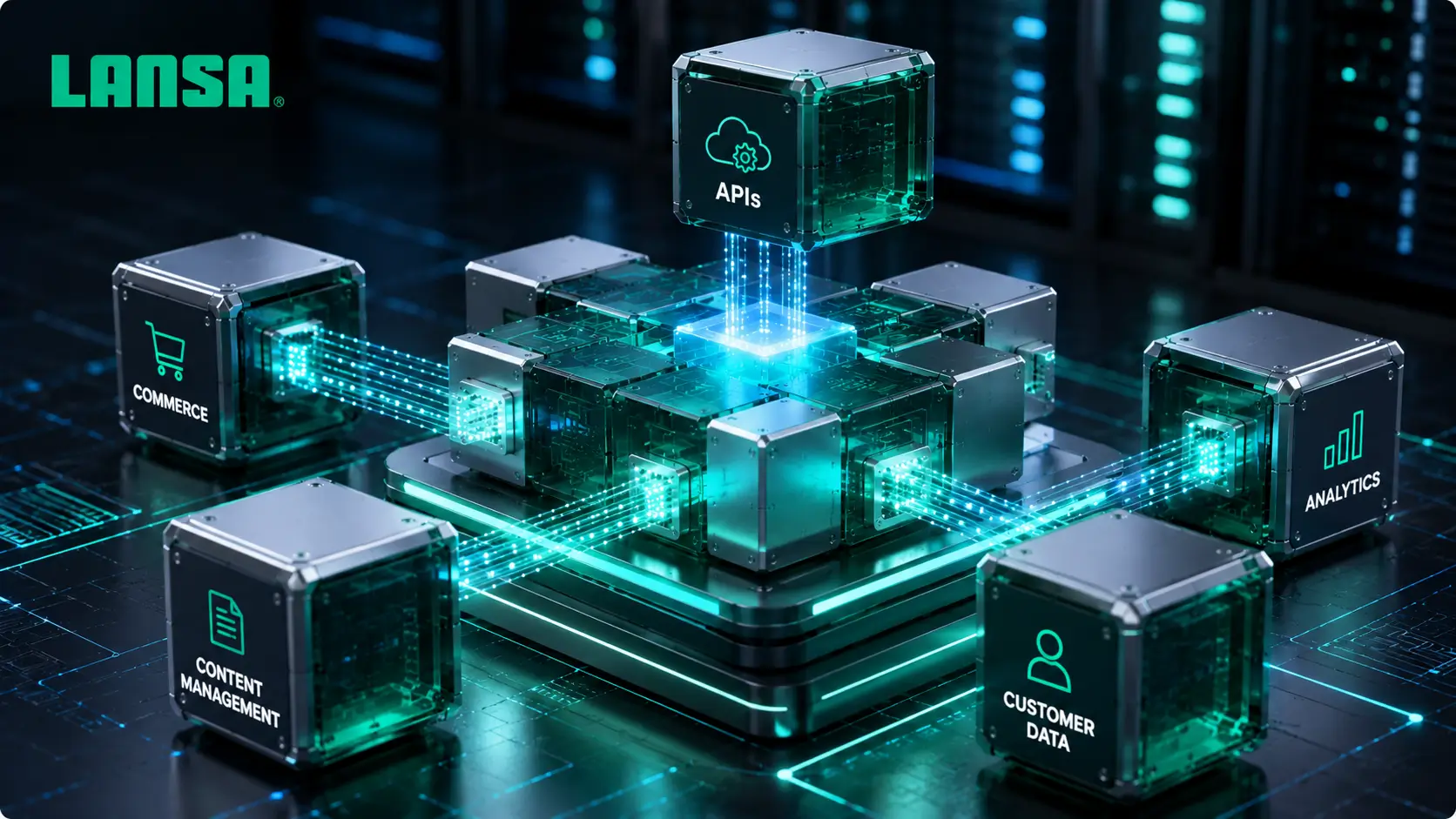
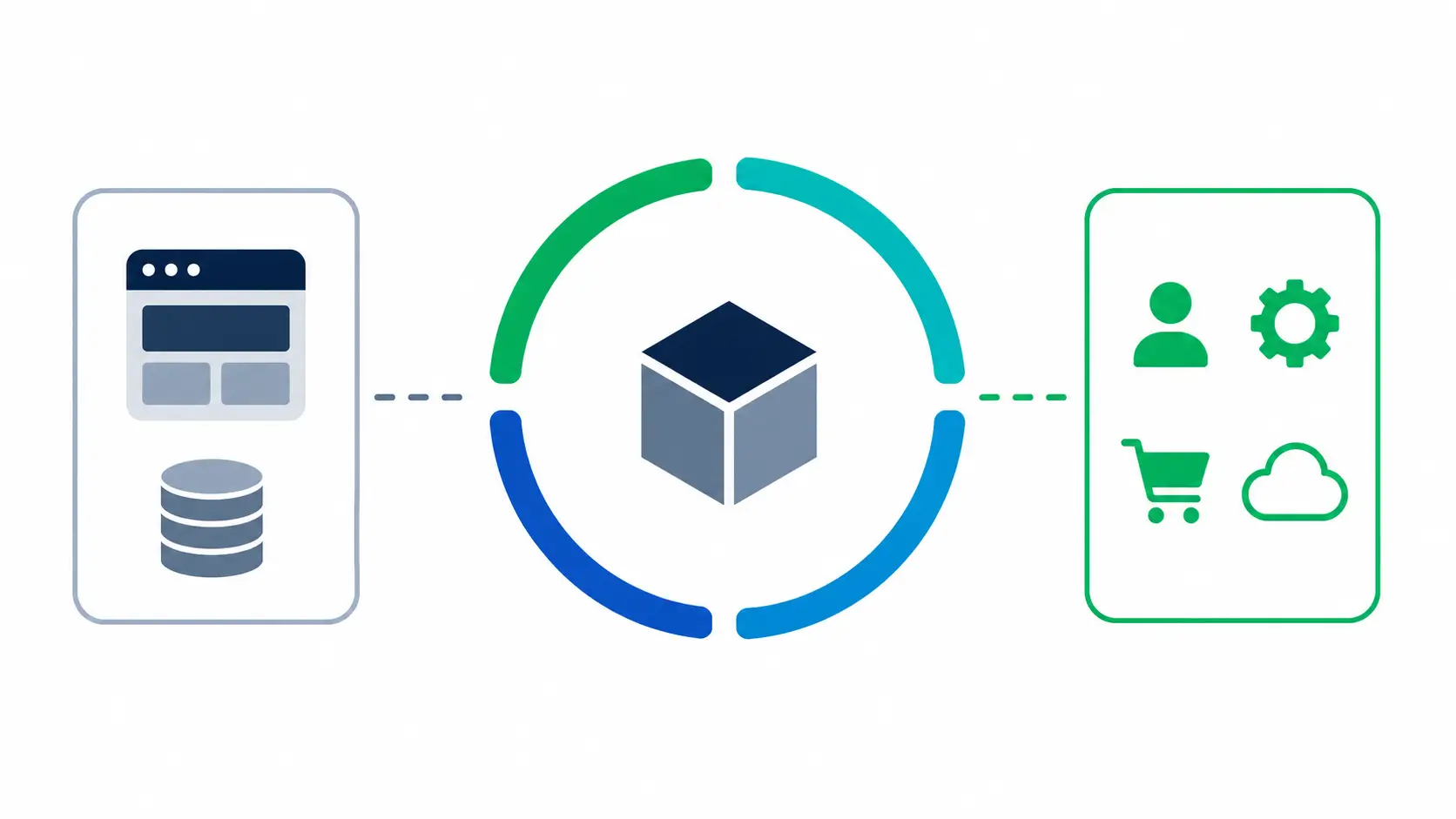


MACH architecture is becoming one of the fastest-growing approaches for building modern digital systems. Many of you are now looking for ways to move faster, integrate smarter, and keep up with rising customer expectations. MACH gives you a path to do exactly that.
Across industries, teams are moving away from rigid monolithic systems. They want technology that adapts quickly and doesn’t slow them down. MACH offers the flexibility and freedom to change what you need—without breaking everything else.
You may also be exploring composable systems for e-commerce and digital experiences. If so, LANSA’s Composable Commerce Complete and Legacy-Compatible Storefront is a strong example of this shift in action. It shows how organizations can modernize step by step, without replacing the systems they still depend on.
Learn how to Launch a Complete, Legacy-Compatible Storefront Fast by watching our webinar.
Key Insights
Some key takeaways from this blog to guide your MACH architecture journey:
- Adopt modular thinking: Break large systems into smaller, independent components to move faster and reduce the impact of changes across your architecture.
- Integrate smarter with API-first: Use consistent, secure APIs to connect services, simplify integrations, and prepare your systems for future expansion.
- Leverage cloud-native scalability: Improve reliability and performance by running services in the cloud, enabling automatic scaling and streamlined deployment workflows.
- Deliver flexible experiences with headless: Build front ends that can adapt to any channel or device, while keeping your backend stable and future-ready.
- Accelerate modernization with expert support: Use LANSA’s low-code platform and Professional Services to adopt MACH safely, integrate legacy systems, and modernize at your own pace.
Read on to learn more.
What Is MACH Technology?
MACH technology is a modern way of building digital systems using modular and flexible components. It stands:
- Microservices-Based
- API-First
- Cloud-Native
- Headless
Each part helps your teams move faster and build solutions that can change without heavy rework.
Microservices
Microservices break a large application into smaller, independent units. Each unit can be updated or scaled on its own without disrupting the whole system. This approach lowers risk and speeds up feature delivery.
API-first
An API-first model ensures every function communicates through well-designed APIs from the start. This creates easier, more consistent integrations across systems. New tools and channels can be added without rebuilding the core platform.
Cloud-native
Cloud-native systems run directly in the cloud and take advantage of its flexibility. They gain automatic scaling, higher reliability, and reduced maintenance. Deployments become faster and less dependent on physical infrastructure.
Headless
Headless architecture separates the front end from the backend logic. This enables content and experiences to be delivered across any channel or device. Teams can experiment with new interfaces without affecting core systems.

MACH Technology Adoption
MACH adoption continues to rise as enterprises shift away from rigid, monolithic systems. Many organizations are now prioritizing faster delivery, easier integrations, and architectures that can evolve without long upgrade cycles.
A growing number of organizations are already moving toward modular and composable systems. Gartner reports that 70% of large and midsize organizations include composability as a key criterion when evaluating new technology investments . This shows a clear shift toward architectures built on microservices, APIs, and adaptable components.
Cloud adoption trends also support this direction. As of 2025, 94% of enterprises use some form of cloud services. This growing reliance on cloud infrastructure makes the cloud-native foundation of MACH easier for your teams to adopt at scale.
Analysts further predict that at least 60% of new B2C and B2B digital commerce solutions developed for the cloud will align with MACH principles by 2027. This signals strong long-term growth, especially in retail and commerce.
Learn about cloud migration strategy, process, and benefits.
Taken together, these trends show that MACH is no longer experimental. It is becoming a mainstream strategy for enterprises planning large-scale modernization with less risk and more flexibility.
What Is MACH Architecture?
MACH architecture is a modern way of designing digital systems using modular, independent building blocks. Instead of relying on one large, tightly connected platform, MACH allows every part of the system to evolve on its own. This creates an ecosystem that can adapt quickly to new requirements.
At its core, MACH architecture is about freedom and flexibility. Each component—whether it handles checkout, search, inventory, or content—can be replaced, upgraded, or scaled without touching the rest of the system. This reduces the fear of breaking something when making changes.
MACH also supports a more open technology environment. Teams can choose the tools and services that work best for their business, rather than being locked into a single vendor or platform. It creates a more future-ready foundation by encouraging modern standards, open integration, and continuous improvement.
For many of you working in complex enterprises, MACH architecture offers a way to innovate faster without disrupting mission-critical operations. It provides the structure needed for large organizations to modernize step by step, instead of attempting risky, all-at-once migrations.

MACH Architecture vs. Traditional (Monolith) Architecture
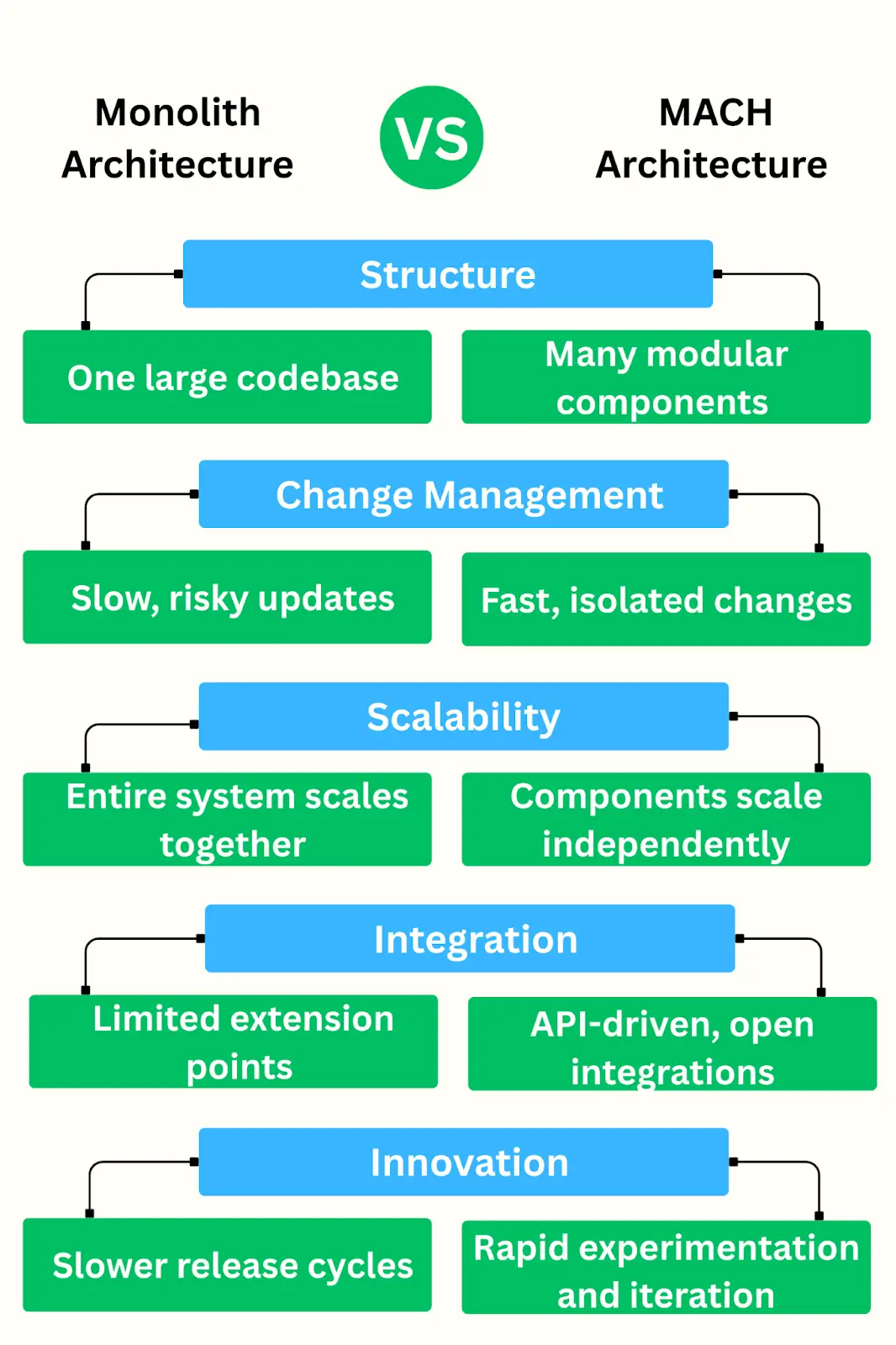
MACH architecture differs sharply from traditional monolithic systems. A monolith keeps everything inside one large, interconnected codebase. MACH breaks that structure apart and distributes it across smaller, independent components. These differences shape how teams build, scale, and maintain digital systems.
A monolithic system is stable but rigid. Changes often require touching multiple parts of the application, which slows delivery and increases risk. MACH takes the opposite approach. Each component operates on its own, so updates and replacements become faster and safer.
Integration also works differently. Monoliths rely on internal connections that are difficult to extend. MACH uses open APIs, making it easier to plug in new tools, channels, or services. This gives organizations more freedom to evolve their digital stack over time.
What Are the Benefits of MACH Architecture?
MACH architecture creates a more adaptable, scalable, and future-ready digital foundation. It helps organizations move faster, reduce operational friction, and modernize without major disruption. These benefits are especially valuable for teams managing complex, enterprise-level systems.
Accelerate Time-to-Market With Minimized Risk
MACH allows each part of the system to evolve independently. This means new features, fixes, or integrations can be released without touching the entire application.
The result is shorter delivery cycles and fewer breaking changes.
Smaller, isolated deployments also reduce risk. Teams can test and roll out updates in controlled phases, instead of making large, risky releases.
Achieve Greater Flexibility With Tailor-Made Solutions
MACH architecture achieves flexibility by decoupling systems into independent components. Each service—such as checkout, search, content, or payments—can be selected, replaced, or scaled without affecting the rest of the platform. This allows organizations to adapt their technology stack as business needs change.
Because capabilities are connected through APIs, teams are free to choose the tools that best fit each use case. New services can be added, upgraded, or removed without requiring a full platform rebuild. This creates a true best-for-purpose approach rather than a one-size-fits-all solution.
This same principle underpins Composable Commerce, where commerce platforms are assembled from specialized components instead of a single monolithic system. LANSA’s Composable Commerce Complete and Legacy-Compatible Storefront reflects this model by enabling modern commerce experiences while continuing to leverage existing backend systems. It demonstrates how flexibility can be achieved without abandoning trusted enterprise foundations.
Learn more about Composable Commerce for eCommerce modernization by reading our whitepaper.
Adopt an Industry-Leading & Future-Proof Technology Strategy
Technology evolves quickly. MACH provides a structure that can adapt to it.
Open APIs, cloud-native principles, and decoupled services allow organizations to adopt new innovations without overhauling the entire stack.
This reduces the risk of technology stagnation. It also keeps long-term investments aligned with industry standards, not tied to outdated architectures or fixed vendor roadmaps.
Eliminate the Burden of Traditional Upgrades
Monolithic systems often require large, time-consuming upgrades. These upgrades can disrupt operations, strain teams, and delay other priorities.
MACH removes this burden.
With modular components, upgrades happen in smaller, more manageable steps. Each service can be updated independently, allowing organizations to stay current without pausing development or risking downtime.
Enable Rapid Modernization and Customization
Modernization projects often fail because they require too much change at once. MACH supports a phased journey instead.
Teams can modernize one component at a time, starting with the areas that deliver the biggest impact.
Customization also becomes easier. Because the system is not tightly coupled, each service can be adapted, extended, or replaced without affecting the rest of the environment.
This helps you all build solutions that match real business needs—without being restricted by the limitations of a monolith.
Challenges of MACH Architecture
MACH architecture delivers strong advantages, but it also introduces new layers of complexity. Organizations need the right skills, governance, and tools to manage a distributed, modular environment effectively. These challenges don’t prevent adoption—but they do require planning and clear execution.
Higher Architectural Complexity
- Multiple microservices, APIs, and cloud components must work together.
- Coordination becomes harder as the system grows.
Skill Gaps in Development Teams
- Many teams lack deep experience in microservices, API design, or cloud-native patterns.
- Additional training or new roles (DevOps, SRE, platform engineering) may be needed.
Increased Cost Management Needs
- Multiple services and vendors can raise initial setup costs.
- Ongoing cloud expenses must be monitored to prevent overspending.
More Demanding Monitoring and Observability
- Distributed systems require unified logging, tracing, and monitoring tools.
- Incident response becomes more complex when many components are involved.
API Governance and Integration Challenges
- APIs must be consistent, secure, and well-documented.
- Poor governance can create friction when connecting legacy or third-party systems.
Potential Strain on Legacy Systems
- Integrating older platforms with modern microservices may require additional layers or refactoring.
- Data flow and synchronization become critical concerns.
Factors to Consider When Evaluating MACH Architecture
Before adopting MACH architecture, organizations need to assess readiness, not just understand the technology. MACH introduces a different way of building, operating, and governing systems. Evaluating these factors early helps determine whether MACH aligns with your organization’s skills, structure, and long-term strategy.
Microservices Readiness
- Are your business domains clearly defined?
MACH works best when applications can be split into independent services with clear ownership. Blurred responsibilities increase complexity and slow delivery. - Can your teams manage distributed systems?
Microservices introduce more moving parts. Organizations must be ready to handle service coordination, monitoring, and cross-team dependencies. - Do you have mature deployment and testing practices?
Frequent releases across multiple services require automation, CI/CD pipelines, and strong quality controls.
API-First Maturity
- Do you have standards for API design and governance?
MACH depends on consistent, well-governed APIs. Without clear standards, integrations become fragile and difficult to maintain.
Read about creating APIs with Visual LANSA.
- Is security built into your API strategy?
An API-first model increases exposure. Authentication, authorization, rate limiting, and monitoring must be part of the evaluation process. - Can your organization support API documentation and lifecycle management?
APIs must be discoverable, documented, versioned, and maintained over time to support long-term scalability.
Cloud-Native Preparedness
- Is your organization ready to operate cloud-native infrastructure?
MACH assumes comfort with cloud platforms, containers, scaling models, and modern deployment patterns. - Do you have visibility into cloud cost management?
Cloud-native systems scale easily—but costs can grow just as quickly. Strong cost controls and monitoring are essential. - Can your architecture support high availability and resilience?
Cloud-native does not guarantee reliability. It must be designed intentionally with redundancy, observability, and fault tolerance.
Learn how to accelerate your digital transformation with low-code in the cloud.
Headless and Front-End Capabilities
- Are your teams prepared to manage decoupled front ends?
Headless architecture shifts responsibility to front-end teams. This requires stronger frontend engineering and experience design skills. - Can your organization support multi-channel delivery?
MACH enables omnichannel experiences, but only if teams can manage multiple interfaces consistently and efficiently. - Are content workflows ready to change?
Headless systems require new approaches to content modeling, previews, and publishing. Editorial teams must adapt to this shift.
Implementing MACH Architecture in Your Organization
Moving to MACH architecture is not a single step. It is a phased journey that reshapes how systems are built, integrated, and maintained. The transition works best when guided by clear goals and a structured roadmap.
The first step is understanding where change is needed most. Some organizations start with customer-facing layers like storefronts or content delivery. Others begin with backend services that limit speed or scalability. Choosing the right entry point reduces risk and helps you all see value early.
Strong governance is essential. MACH introduces many independent components, so teams must align on standards for APIs, security, tooling, and deployment. Without a shared framework, complexity can grow quickly.
Integration with existing systems also needs planning. Many enterprises cannot replace legacy platforms all at once. A gradual approach—modernizing one service at a time—works well. This lets your teams adopt MACH without disrupting core operations.
Because the journey can feel overwhelming, many organizations partner with experts who understand both modern architectures and legacy environments. LANSA Professional Services supports this transition with hands-on guidance, low-code solutions, and modernization strategies built for complex enterprise systems. IT experts will help map your migration path, build new services, and ensure that MACH principles work effectively within your environment.
With the right support, MACH becomes easier to adopt—and far more impactful over time.
Transition to MACH for IBM i Developers
IBM i developers are now facing a major shift in how modern systems are built and delivered. Many long-running applications still depend on tightly coupled designs, but business needs are changing fast. MACH architecture offers a path forward that preserves stability while opening the door to modern capabilities.
For many IBM i teams, the goal is not to replace the platform entirely. Instead, the focus is on extending it. MACH allows IBM i applications to coexist with new cloud services, APIs, and modular front ends. This creates a hybrid model where the trusted core stays in place, while new experiences and integrations grow around it.
The transition starts by exposing existing IBM i functions through APIs. Once APIs are in place, they can support microservices, headless interfaces, and cloud-native tools. This step-by-step approach helps teams modernize without rewriting everything at once.
Skill development also becomes important. IBM i developers benefit from learning API design, cloud workflows, and modern integration patterns. These skills make it easier to connect legacy logic to newer, composable systems.
Many organizations choose to bring in expert support during this journey. Guidance from teams who understand both IBM i and MACH can reduce risk and help avoid common pitfalls. With the right strategy, IBM i developers can modernize their applications, extend their systems, and stay aligned with the future of enterprise architecture.
Learn more about migrating IBM i applications to the cloud in this recorded webinar.
Conclusion
MACH architecture gives organizations a modern, flexible foundation for building digital systems that can evolve without heavy disruption. It supports faster delivery, easier integrations, and long-term scalability—without forcing a complete overhaul on day one. With the right strategy and guidance, any enterprise can take a phased, low-risk path toward a more composable future.
If you all are ready to explore what MACH could mean for your business, we’re here to help. LANSA Professional Services can guide your teams through modernization, API development, cloud alignment, and integration with your existing IBM i or enterprise systems.
Start planning your MACH journey today. Contact us to consult with our experts for free and explore modernization solutions built for real enterprise needs.
References
[1]: ProcessMaker. “Composable Enterprise: What Is It and Why Does It Matter?” ProcessMaker Blog. 2024. Available: https://www.processmaker.com/blog/the-composable-enterprise/
[2]: Zippia. “Cloud Adoption Statistics.” Zippia. 2025. Available: https://www.zippia.com/advice/cloud-adoption-statistics/
[3]: MACH Alliance. “MACH Is Making an Impact.” MACH Alliance Insights Hub. 2024. Available: https://machalliance.org/insights-hub/mach-is-making-an-impact